Pluto: an AI agent that runs a content agency's daily workflow
A production AI operations agent I designed, built and run for Plutus Media, a UGC and organic-content agency. It lives in Slack, drafts and publishes content in the founder's voice, analyses every sales call, and turns a closed verbal agreement into a fully cited delivery brief within five minutes. 19 skills, 7 scheduled automations, 12+ integrations, one small EC2 box.
The problem
A content agency's operating loop is a chain of small, constant jobs: draft the next post, check what competitors shipped, brief the next sales call, write the proposal, hand a closed deal to delivery. Each one is quick. Together they consume the team's week. Pluto exists so the whole team can hand that loop to an agent in plain language, in the Slack workspace they already live in. No new tool, no dashboard.
What it does
Nineteen production skills across three areas, each written as a hardened contract with numbered checkpoints so the agent cannot quietly skip steps.
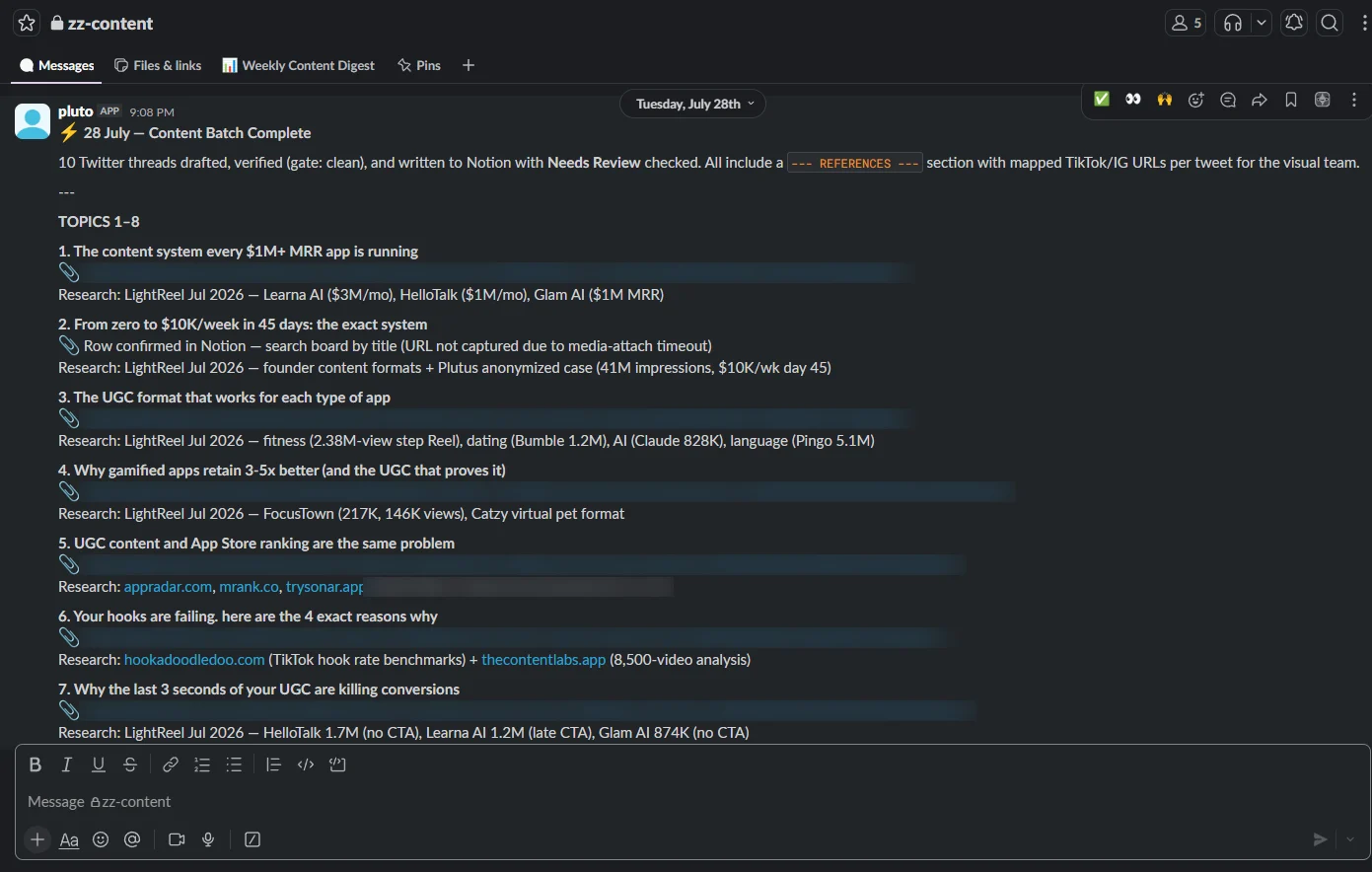
- Content production: drafts in the founder's voice, suggests weekly topics from a rolling window, composites visual assets and thumbnails, attaches real platform media, converts high-performing tweets into other formats. Publishes into five Notion boards under one shared schema.
- Competitive intelligence: finds and scans competitors, tracks accounts, analyses top posts and content gaps, ships a weekly content-intelligence digest nobody has to ask for.
- Sales and revenue ops: analyses every sales call from meeting transcripts, researches prospects before calls, drafts proposals, recaps rep trends, coaches reps.
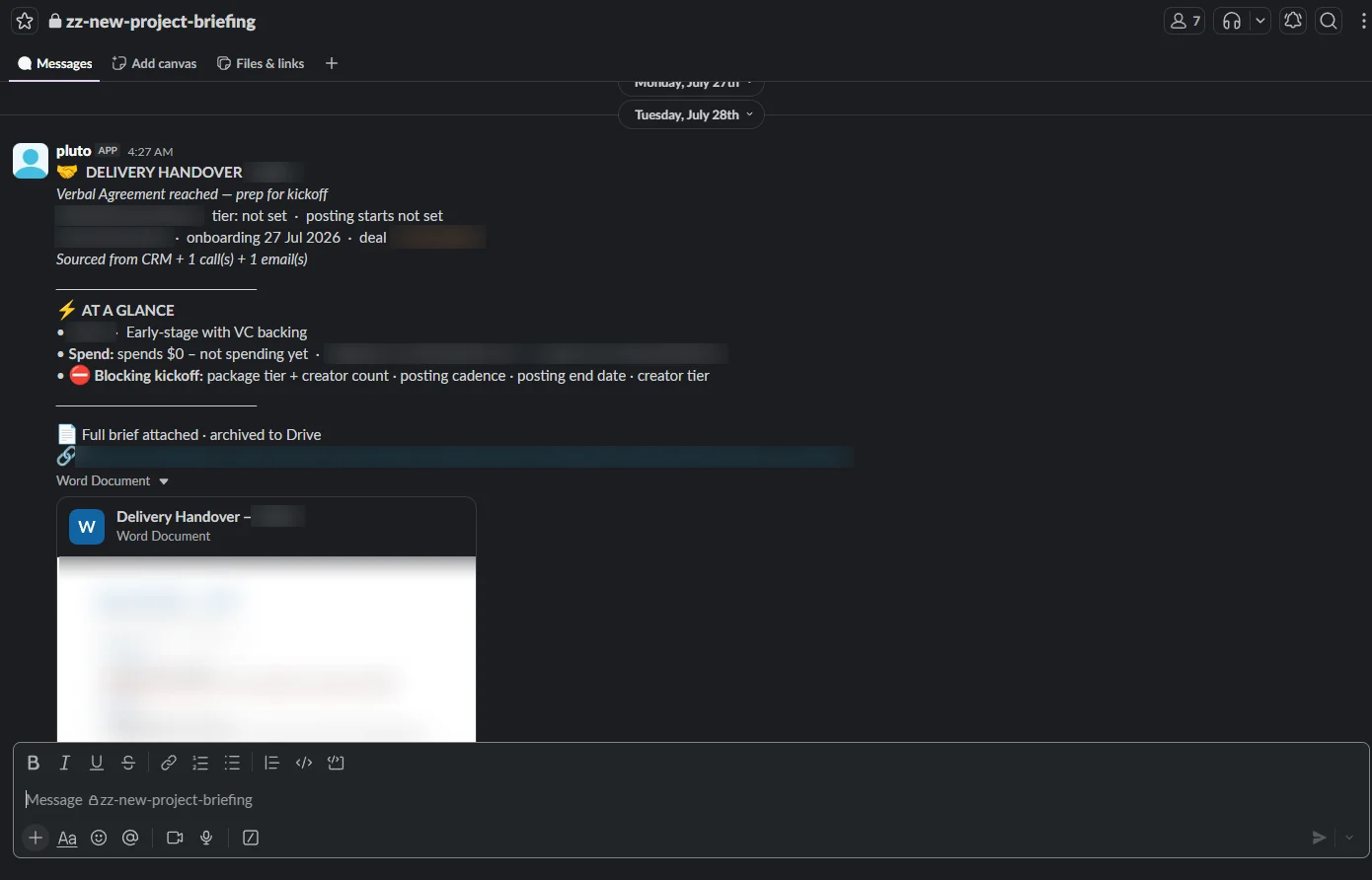
The most end-to-end piece: when a deal reaches verbal agreement in the CRM, a five-minute poller pulls the deal, its contacts, emails and meeting transcripts, runs a 20-field extraction with citations through Claude Opus, generates a Word delivery brief, and files it to the right Slack channel and the right shared drive. A sales handshake becomes a delivery document with no human step.
The flagship piece: proof cards that cannot lie
Content drafts need social proof cards showing a post's real engagement numbers. Reconstructed screenshots look fake and, worse, can fabricate numbers. So cards are real screenshots of the platform's own page, captured by a headless browser. The only thing drawn locally is a red ring around the metric being highlighted.
The anti-fabrication rules are code-level invariants, not prompt instructions. Counts are truncated with integer math, never rounded, because rounding across a magnitude boundary is the most recognisable tell in a faked screenshot. A card with a missing metric fails rather than rendering a zero. Anything containing exact numbers or text is composited with a deterministic pixel-exact paste, verified byte-exact, and is never regenerated by an image model.
Built for hostile terrain
The platforms being captured actively resist automation, and the agent runs on a 3.8 GB box with no swap. That shaped everything: browser renders are serialised behind an exclusive lock so two Chromium jobs never trip the OOM killer, thumbnails ride a five-model failover chain (four image models, then a second provider, then a deterministic render) so production survives a provider outage, and the scraper follows rules like "never fuzzy-match text to click" after a consent-dialog selector once clicked the platform's Save button instead. Every generated thumbnail still routes to a human approval channel before it ships.
The outcome
Pluto runs in production, in continuous development. The team talks to it in plain language. Content ships with proof assets that cannot misrepresent performance, every sales call gets analysed without anyone asking, and a closed deal becomes a cited delivery brief while the sales rep is still on the follow-up call. Client confidentiality is enforced in code at the single point where anything is written: no client name can appear in any output.
What I learned
The agent confabulates failures: it invents plausible technical explanations when the real error is opaque. Everything gets verified against raw logs and direct API calls, never against the agent's own account of what happened. And the integrity rules that matter cannot live in a prompt. If a card must never show a fabricated number, that has to be enforced where the pixels are made, in code, where the model cannot talk its way around it.